
Tyres
Tyres close to the legal limit: what to check and what to budget
What it means
A tyre was getting close to the legal tread limit when the car was tested, or the tester noticed it wearing more on one edge than the rest. For most cars in the UK, the minimum is 1.6mm of tread across the central three-quarters of the tyre, all the way round (the legal tread limit). This entry records wear that the tester did not fail at that test.
Tyres keep wearing as the car is used. An advisory from eight months and 9,000 miles ago tells you very little about what's on the car now. Treat it as a heads-up to measure, not as a description.
So measure. Use a tread-depth gauge, or ask a tyre fitter to measure all four. Compare across each tyre as well as between them — if one edge is noticeably lower than the middle, that's worth understanding before you buy new rubber.
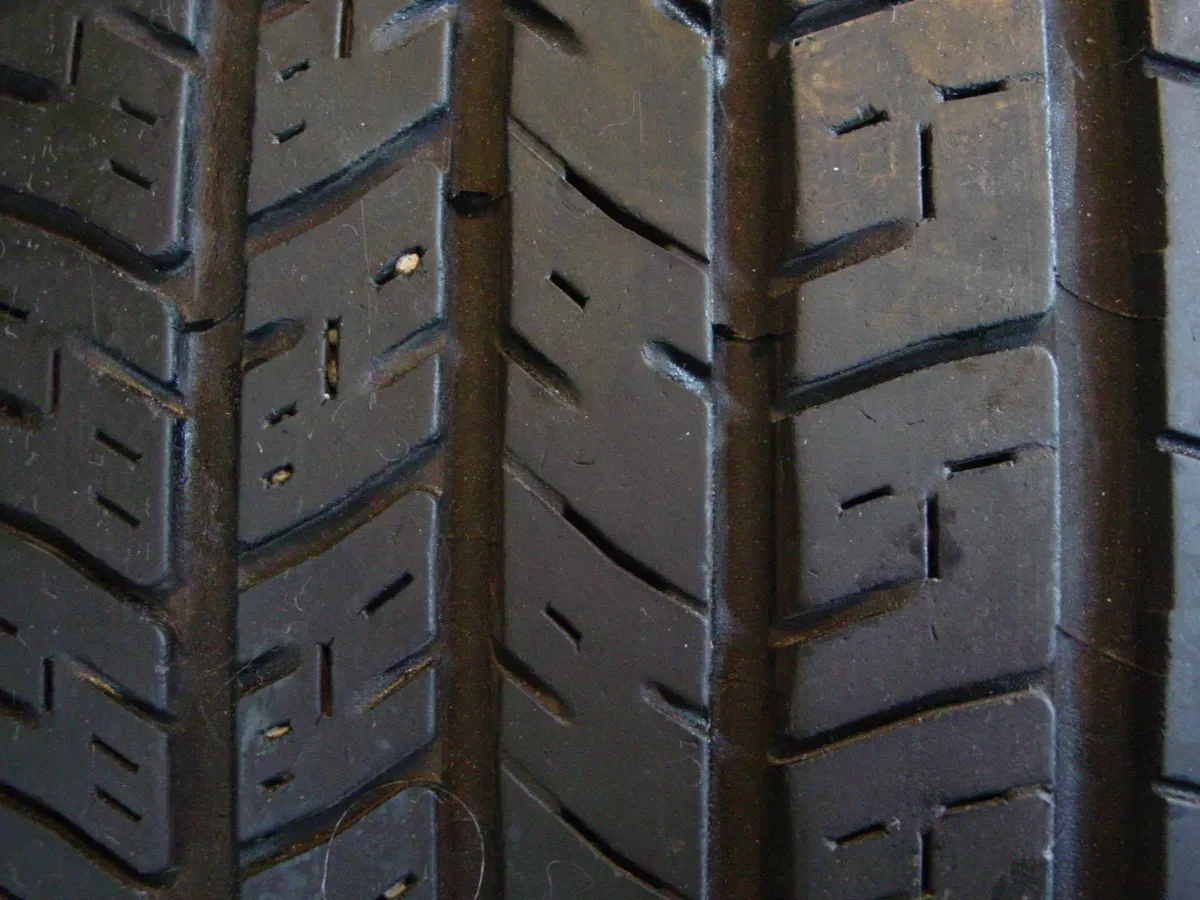
The small raised strips in the grooves are tread-wear indicators. On standard car tyres these mark 1.6 mm; use a gauge to measure the remaining tread. This photo has no verified depth.
Photo: TireZoo / Wikimedia Commons · CC BY 2.0. Converted for display.

Why it happened
Usually: miles. But the wear pattern is a clue worth reading. Tyre makers describe the wear patterns:
- One edge, or a patchy scalloped pattern — can point to alignment (tracking), or a worn suspension component letting the wheel sit at an angle.
- Both edges worn more than the middle — a sign of running under-inflated.
- The middle worn more than the edges — a sign of running over-inflated.
These are clues, not diagnoses; get possible alignment or suspension problems assessed properly. And don't read too much into front and rear wearing at different rates. Tyres on the driven axle can wear faster; different wear rates alone don't establish a fault.
What it costs
For a common 17-inch size, fitted, you're looking at around £60 a corner for a budget tyre, £80 to £90 for a mid-range one, and £130 upwards for a premium brand. Bigger wheels cost more, and the size on your sidewall is what matters. Get a quote for the number of tyres that actually need doing, and if the wear is uneven, include finding out why.
The MOT wording
DVSA's section 5.2.3 covers tyres.
Advisory
"Tyre worn close to legal limit/worn on edge (5.2.3 (e))" is the wording you'll see in histories. It records wear that was still above the failure threshold, and it doesn't give you a depth unless the tester chose to add one.
Dangerous — a failed test
Tread below the requirement is a dangerous defect, and DVSA's instruction is not to drive the vehicle until it's repaired (category guidance). That's a different thing entirely from an advisory about approaching the limit — don't let the similar wording blur them.
If an old failure was followed by a pass, ask for the tyre invoice between those two dates. An advisory disappearing from a later test doesn't prove a tyre was changed on its own.
Great Britain categories; Northern Ireland uses the DVA manual.
What this page can't tell you
An old entry can't give you today's tread depth, how much life is left, or why a tyre wore unevenly. It's a guide to the record, not a diagnosis, and it hasn't been reviewed by a mechanic.
Next
Check a car with Lemoned to see which tyres were mentioned and at which tests. If uneven wear has you wondering about the suspension, see suspension bushes.
Spotted an error? Email hello@lemoned.co.uk with the passage and the source that contradicts it.